Poplin or Twill for a Shirt? Read the Weave First
Compare poplin or twill for a shirt by checking its weave and feel, then choose the surface that suits the look you want from your shirt.
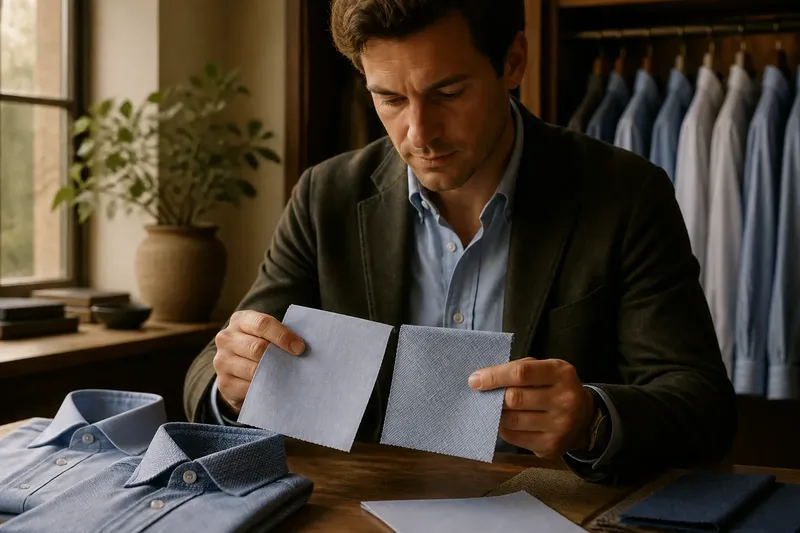
To choose poplin or twill for a shirt, inspect the weave before judging the colour: poplin usually has an even surface, while twill shows diagonal lines. That simple distinction helps you compare the cloth itself, rather than relying on a product photo or the fabric name alone.
What can you see in the weave?
Poplin is a plain weave, with threads crossing over and under one another in a regular grid. In a finished shirt, it often looks clean and relatively flat. Fibre, yarn and finishing can change the surface, so “smooth” is a common impression, not a promise about every poplin.
Twill has diagonal ribs created by the way its threads cross. The lines may become clearer when you tilt the cloth towards the light. A fine twill can look almost plain from a distance; a more pronounced one makes the diagonal easy to see.
Hold a swatch near a bright window or under shop lighting, and turn it gently. Look for an even, grid-like surface or repeated diagonal lines. On a finished shirt, inspect an unobstructed part of the front panel rather than a fold or a busy print.
How do poplin and twill look and feel?
Poplin often gives a shirt a crisp, straightforward appearance. Its flatter face can make checks, stripes and solid colours look sharply defined. Depending on its fibre and finish, it may feel light and neat in the hand.
Twill adds visual depth through its diagonal texture, even in a plain colour. It can feel more textured, and its surface may make a shirt seem less stark than a smooth poplin in the same shade. Twill covers a broad family of fabrics, so the name alone does not tell you how heavy or pronounced the texture will be.
For a useful comparison, choose cloth with similar fibre content and garment weight. A fine cotton twill and a light cotton poplin may feel closer than their names suggest. If the fibre or finish differs, keep that in mind rather than attributing every difference to the weave.
How can you compare poplin or twill for a shirt in the shop?
Use a brief side-by-side check instead of spreading the choice over several days. You need a poplin and a twill swatch, or two shirts; a light source; and the labels, if available. Compare them in this order:
- Check the labels: Read the fibre content. If it differs, treat feel as a comparison of the whole cloth, not just the weave; if it matches, you can make a closer comparison.
- Look at the surface: Tilt each cloth under window or shop light. If you see diagonal ribs, note the twill; if the face looks like a level grid, note the poplin.
- Feel the fabric: Use clean, dry hands. If you prefer a flatter face, favour the poplin; if you like a more noticeable texture, favour the twill.
- Check the pattern: Compare plain or quiet-coloured areas first. If a bold print hides the weave, look at an unprinted section or ask to see a swatch.
- View it at a distance: Hold the shirt at the distance you would normally see it. If you want a crisp, even appearance, lean towards the poplin; if you want subtle surface detail, lean towards the twill.
- Consider the outfit: If you want the shirt to sit quietly beside a patterned tie, the poplin’s flatter face may suit that aim; if the shirt will be worn plain, the twill’s diagonal may add interest. Choose by the effect you prefer, not by a fixed rule.
Say you are choosing between two blue shirts. For this invented example, imagine both labels show cotton and the fabrics feel similar in weight. Under shop lighting, you see a flatter surface on the poplin and fine diagonals on the twill; the poplin also looks quieter beside your striped tie, while the twill adds texture when viewed on its own. If you want the shirt to recede beside the tie, choose the poplin; if you want texture without a print, choose the twill. The deciding trade-off is visual character, not a claim that one shirt is better.
Which weave suits the look you want?
Choose poplin if you favour a smooth-looking surface and clear pattern definition. It is a natural option for a shirt intended to look crisp and uncomplicated. Check the cloth itself, since a particular poplin may feel softer or appear less formal than its name suggests.
Choose twill if you like a visible diagonal and a more textured surface. A fine twill can add interest to a plain shirt without a print. If the diagonal matters to your outfit, inspect the fabric in person; its prominence varies.
The weave is only one part of a shirt’s character. Collar shape, cut, colour, fibre and finish also affect its appearance and feel. Let the weave answer a focused question: do you want an even face or a diagonal one?
What questions come up when comparing shirt weaves?
Is poplin always smoother than twill?
Poplin commonly has a flatter-looking surface, while twill has diagonal ribs. Yarn, fibre and finishing can make a particular poplin feel less crisp or a fine twill seem nearly smooth.
Can you spot twill without a magnifying glass?
Often, yes: tilt the cloth towards the light and look for repeated diagonal lines. If the ribs are very fine, inspect the fabric close up.
Does a printed shirt hide its weave?
A bold print can draw attention away from the fabric structure. Look at a quieter area or turn the shirt so the light catches its surface.
Should you choose by weave name alone?
No. Treat “poplin” and “twill” as clues to structure, then check the actual fabric and how it suits your preferences. Fibre content and finishing can change the hand and appearance.
What should you check before choosing?
When comparing poplin or twill for a shirt, look for the weave, feel the surface and consider the outfit you have in mind. If a product description is vague, ask to see the cloth close up. Use the garment label and maker’s information for fibre details and care guidance.
Keep your preference specific: “I like a smooth, even face” or “I like a fine diagonal” is more useful than deciding that one weave is always smarter or softer. That distinction gives you a clear basis for choosing the next shirt.