How Trouser Cuffs Became a Tailoring Choice
Learn how trouser cuffs became a tailoring choice, and decide whether a turned hem suits your fabric, trouser shape, shoes and intended use.
A turned hem changes the look of a pair of trousers before you notice any other alteration. Trouser cuffs are a tailoring choice, not a detail with one settled meaning: their effect depends on the cloth, the cut and the dress setting around them.
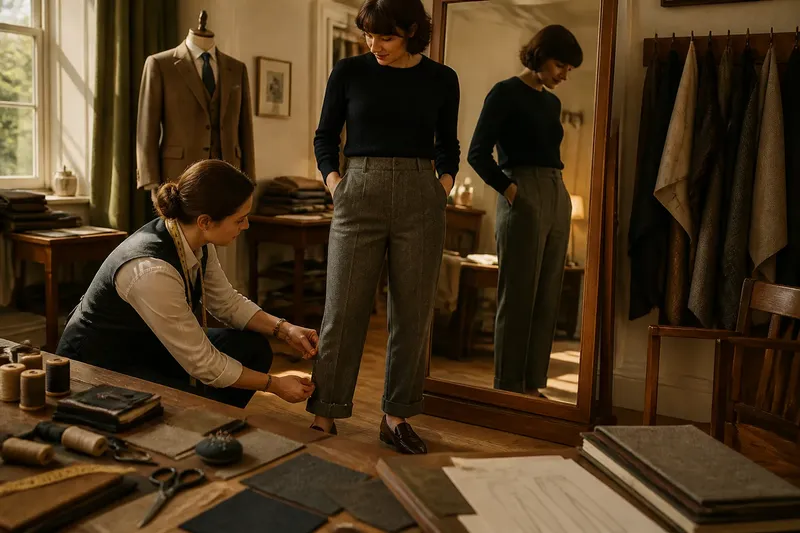
Imagine Mara, an invented wearer, bringing straight-leg wool trousers to an alterations shop. She usually wears them with loafers or low boots and wants a more substantial finish, but she is unsure whether a cuff will suit both. Her tailor pins the hem and folds the fabric out so she can compare the plain and cuffed versions in the mirror. That comparison shows how a small construction choice can express personal taste as well as the conventions of tailored dress.
What does a trouser cuff change?
A cuff is a turned or separately constructed band at the lower edge of a trouser leg. It adds visible weight and creates a horizontal line above the shoe. Depending on the cloth and the cut, the hem can look more defined, draw attention to the ankle or make the trouser leg seem more substantial.
The practical explanation often given for turn-ups is that they can keep the trouser edge clear of dirt. That is plausible in some settings, but it should not be treated as a complete origin story. Without a specific documented example to anchor the claim, it is safer to describe dirt protection as one possible use rather than the single reason cuffs appeared.
A cuff also makes the finish visible. A plain hem keeps the edge discreet; a turned hem announces that the edge has been shaped as part of the garment’s design. In tailored clothing, that detail sits alongside the leg’s width, the break over the shoe and the formality of the fabric.
Why are trouser cuffs associated with tailoring?
The association comes from the cuff’s deliberate, structured appearance. On pressed wool trousers, a clean turn-up can look like a considered finishing choice. It is not, however, a universal sign of formality: denim, cotton and other casual fabrics can be rolled or turned in ways that read as relaxed.
It is more accurate to talk about a continuing option than to claim that cuffs disappeared and returned in a clear historical cycle. The same construction can carry different associations in different settings. A tailored cuff may suggest convention or polish to one wearer, while another chooses it simply because it balances the line of a trouser leg.
Context does the work. Compare the fabric, the cut and the shoes rather than assuming that the cuff alone makes an outfit formal or informal.
How should you decide whether to add a cuff?
Start with the trousers’ intended use, then consider how their shape meets your usual shoes. A cuff adds a band of visual weight; if the leg is very slim or the fabric is soft and fluid, that band may look bulky. A more structured cloth and a straighter or wider leg can make the edge look more at home, though neither pairing is a strict rule.
- Check the fabric at the hem: if it holds a crisp fold, ask the tailor to show a cuff; if it collapses, compare a plain hem or a softer finish instead.
- Check the leg shape from knee to ankle: if the cuff crowds a narrow opening, keep the hem plain or ask to see a more restrained turn-up.
- Check the shoes you actually wear: if their shape balances the added band, compare the cuff with them on; if the cuff overwhelms a delicate shoe, view a plain hem instead.
- Check the intended setting: if the trousers are for tailored dress, compare a pressed cuff with a plain finish; if they are for relaxed wear, consider a simple roll or an unadorned hem.
- Check the current length while wearing your usual shoes: if the fabric already breaks heavily, ask the tailor to pin the length before choosing a cuff; if the hem sits cleanly, compare both finishes at that length.
- Check the fabric allowance inside the hem: if there is enough cloth for the proposed alteration, ask to see the fold pinned before agreeing; if there is not, retain the existing finish or discuss another option with the alterations professional.
Say Mara’s invented trousers have a structured wool cloth, a straight leg, and enough inside allowance for the tailor’s proposed cuff. She puts on her loafers and sees the pinned plain hem sit cleanly, while the folded version gives the ankle a more defined edge without crowding the shoe. She then tries the same trousers with her low boots: the cuff still balances the footwear, so she chooses it for this pair. If the fabric had slumped when folded or the cuff had overwhelmed either shoe, the observable comparison would have pointed her towards a plain hem instead.
Bring the shoes you expect to wear and ask to see the proposed finish pinned before any permanent alteration.
Which questions about trouser cuffs should you ask?
Do trouser cuffs make an outfit more formal?
Not by themselves. A cuff can look considered on pressed tailoring, but the cloth, cut, condition and occasion shape the overall impression.
Can a cuff change how long a trouser leg appears?
The strong horizontal edge can draw the eye to the ankle. The effect varies with the trouser length, leg width and footwear.
Should every pair of trousers have the same hem?
No. Different pairs can have plain hems, tailored cuffs or casual rolled edges. Choose a finish to suit each garment’s shape and use.
Can an existing plain hem be changed to a cuff?
Sometimes. An alterations professional needs to inspect the cloth inside the hem to see whether there is enough allowance for the change.
What can a cuff tell you about fashion history?
A cuff shows how a garment detail can acquire associations without keeping one fixed purpose. Its visible construction may suggest traditional tailoring in one context and casual styling in another. Rather than assigning it a single origin or claiming a neat cycle of revival, read it as a choice shaped by both garment conventions and the wearer’s own priorities.
When considering trouser cuffs, judge the finish beside the fabric, leg shape, hem allowance and shoes. That gives you a sound basis for deciding whether the detail belongs on this particular pair, without needing to treat it as either a rule of tradition or a passing trend.